

How To Run With The Bulls
| Running of the bulls | |
|---|---|
 The bull run in Pamplona | |
| Dates | 7–14 July (in 2022) |
| Location(south) | Pamplona and other |
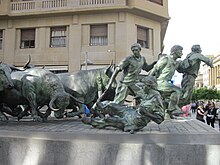

Runners surround the bulls on Estafeta Street
A running of the bulls (Spanish: encierro, from the verb encerrar, 'to corral, to enclose'; Occitan: abrivado, literally 'haste, momentum'; Catalan: correbous, 'run-bulls') is an upshot that involves running in front of a small group of bulls, typically six[one] just sometimes ten or more, that have been let loose on sectioned-off streets in a town,[i] ordinarily equally office of a summertime festival. Particular breeds of cattle may be favored, such as the toro bravo in Spain,[i] also oftentimes used in mail-run bullfighting, and Camargue cattle in Occitan France, which are non fought. Bulls (non-castrated male cattle) are typically used in such events.
History [edit]
The most famous bull-run is the encierro held in Pamplona during the nine-twenty-four hour period festival of Sanfermines in honor of Saint Fermin.[ii] It has become a major global tourism consequence, today very unlike from the traditional, local festival. More traditional summertime bull-runs are held in other places such as towns and villages across Spain and Portugal, in some cities in Mexico,[iii] and in the Occitan (Camargue) region of southern France. Bull-running was formerly also practiced in rural England, most famously at Stamford until 1837.
The event has its origins in the old practice of transporting bulls from the fields outside the urban center, where they were bred, to the bullring, where they would be killed in the evening.[4] During this "run", local youths would jump amidst them in a display of blowing. In Pamplona and other places, the six bulls that run are also in that afternoon'south bullfight.
Castilian tradition holds that balderdash-running began in northeastern Espana in the early 14th century. Cattle herders who wanted to send their animals from barges or from the countryside into city centers for auction or bullfights needed an easy way to move their precious animals. While transporting cattle in order to sell them at the marketplace, men would endeavour to speed the procedure by hurrying their cattle using tactics of fearfulness and excitement. Afterwards years of this practise, the transportation and hurrying began to turn into a competition, as immature adults would try to race in forepart of the bulls and brand it safely to their pens without beingness overtaken. When the popularity of this practice increased and was noticed more and more by the expanding population of Spanish cities, a tradition was created and stands to this solar day.[5] [ non-chief source needed ]
The Running was cancelled in 2020 and 2021 due to the COVID-19 pandemic in Spain, but resumed vii–xiv July 2022.[6] [vii]
Pamplona bull run [edit]
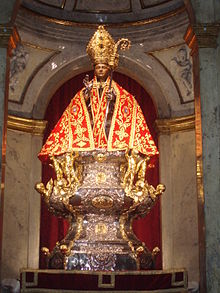
Saint Fermin, honored in Pamplona

Pamplona, vii July 2005. People climb to the fences as the bulls run by and cross the Boondocks Hall Plaza.
The Pamplona[2] encierro is the well-nigh pop in Kingdom of spain and has been broadcast alive by RTVE, the public Spanish national television channel, for over 30 years.[8] Information technology is the highest-profile event of the San Fermín festival, which is held every year from 6–xiv July.[two] The first balderdash running is on seven July, followed by one on each of the following mornings of the festival, beginning every day at 8 am. The rules require participants to be at least 18 years old, run in the same direction equally the bulls, not incite the bulls, and not be under the influence of alcohol.[ix] [10]
Argue [edit]
In Pamplona, a ready of wooden fences is erected to directly the bulls along the route and to block off side streets. A double wooden argue is used in those areas where there is enough space, while in other parts the buildings of the street act as barriers. The gaps in the barricades are wide enough for a homo to skid through but narrow enough to block a balderdash. The fence is composed of approximately three m separate pieces of forest. Some parts of the contend remain in place for the elapsing of the fiesta, while others are placed and removed each morning.[11] Spectators can only stand backside the 2nd fence, whereas the space between the 2 fences is reserved for security and medical personnel and also for participants who need comprehend during the event.[10]
Preliminaries [edit]
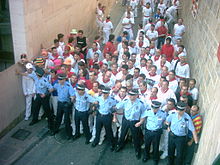
Law barrier at the beginning of the running stops people until the offset rocket is fired.
The encierro begins with runners singing a benediction. Information technology is sung three times, each fourth dimension beingness sung both in Spanish and Basque. The benediction is a prayer given at a statue of Saint Fermin, patron of the festival and the metropolis, to ask the saint's protection and tin exist translated into English language as "We ask Saint Fermin, equally our Patron, to guide us through the encierro and give united states his blessing". The singers finish past shouting " ¡Viva San Fermín! and Gora San Fermin! ('Long live Saint Fermin', in Spanish and Basque, respectively).[ix] Most runners clothes in the traditional clothing of the festival which consists of a white shirt and trousers with a crimson waistband ( faja ) and neckerchief ( pañuelo ). Too some of them concord the day's newspaper rolled to draw the bulls' attention from them if necessary.[9]
The running [edit]
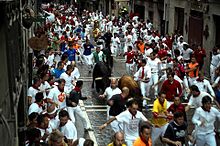
Runners at the Pamplona bull run in typical attire
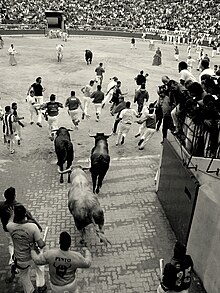
Pamplona, 2007. Bulls following some runners enter the balderdash ring from the callejón, where the event ends. The bulls can be seen in the foreground and background of the picture.
A commencement rocket is set off at 8 a.k. to alarm the runners that the corral gate is open. A second rocket signals that all vi bulls take been released. The third and quaternary rockets are signals that all of the herd has entered the bullring and its corral respectively, marking the stop of the issue.[9] The average duration betwixt the starting time rocket and the cease of the encierro is two minutes, thirty seconds.[9]
The encierro is usually composed of the vi bulls to be fought in the afternoon, six steers that run in herd with the bulls, and three more steers that follow the herd to encourage whatever reluctant bulls to keep along the route. The function of the steers, who run the route daily, is to guide the bulls to the bullring.[9] The average speed of the herd is 24 km/h (15 mph).[9]
The length of the run is 875 meters (957 yards). Information technology goes through four streets of the erstwhile office of the city (Santo Domingo, Ayuntamiento, Mercaderes and Estafeta) via the Town Hall Square and the brusque section "Telefónica" (named for the location of the old telephone part at end of Calle Estafeta) only before entering into the bullring through its callejón (tunnel).[2] The fastest part of the route is up Santo Domingo and across the Town Hall Square, just the bulls oftentimes became separated at the entrance to Estafeta Street as they tiresome down. One or more would slip going into the turn at Estafeta ("la curva"), resulting in the installation of anti-slip surfacing, and now near of the bulls negotiate the turn onto Estafeta and are often ahead of the steers. This has resulted in a quicker run. Runners are not permitted in the first l meters of the encierro, which is an uphill grade where the bulls are much faster.[ citation needed ]
Injuries, fatalities, and medical attention [edit]

Two injured runners are treated by medical services.
Every yr, between 50 and 100 people are injured during the run.[9] Non all of the injuries crave taking the patients to hospital: in 2013, l people were taken by ambulance to Pamplona'south hospital, with this number nigh doubling that of 2012.[12]
Goring is much less common merely potentially life threatening. In 2013, for example, six participants were gored along the festival, in 2012, only four runners were injured by the horns of the bulls with exactly the aforementioned number of gored people in 2011, nine in 2010 and x in 2009; with i of these last killed.[12] [13] As virtually of the runners are male, merely 5 women accept been gored since 1974. Before that date, running was prohibited for women.[14]
Some other major risk is runners falling and piling upwardly (a "montón") at the archway of the bullring, which acts every bit a funnel as it is much narrower than the previous street, resulting in a crowd shell. In such cases, injuries come both from asphyxia and contusions to those in the pile and from goring if the bulls crush into the pile. This kind of blocking of the entrance has occurred at least ten times in the history of the run, the last occurring in 2013 and the outset dating dorsum to 1878. A runner died of suffocation in one such pile upwards in 1977.[fifteen]
Overall, since tape-keeping began in 1910, 15 people accept been killed in the balderdash running of Pamplona, most of them due to being gored.[9] To minimize the impact of injuries every mean solar day 200 people collaborate in the medical attention. They are deployed in xvi sanitary posts (every 50 metres on average), each one with at least a doc and a nurse among their personnel. Most of these 200 people are volunteers, mainly from the Red Cross. In add-on to the medical posts, there are around 20 ambulances. This organization makes it possible to take a gored person stabilized and taken to a hospital in less than 10 minutes.[xvi]
In 2021 a man bled to decease later he was repeatedly gored at a bull-running festival in the city of Onda in eastern Spain.[17]
| Year | Name | Historic period | Origin | Location | Cause of death |
|---|---|---|---|---|---|
| 1924 | Esteban Domeño | 22 | Navarre, Kingdom of spain | Telefónica | Goring[18] |
| 1927 | Santiago Zufía | 34 | Navarre, Spain | Bullring | Goring[18] |
| 1935 | Gonzalo Bustinduy | 29 | San Luis Potosí, Mexico | Bullring | Goring[18] |
| 1947 | Casimiro Heredia | 37 | Navarre, Spain | Estafeta | Goring[xviii] |
| 1947 | Julián Zabalza | 23 | Navarre, Spain | Bullring | Goring[18] |
| 1961 | Vicente Urrizola | 32 | Navarre, Espana | Santo Domingo | Goring[xviii] |
| 1969 | Hilario Pardo | 45 | Navarre, Spain | Santo Domingo | Goring[18] |
| 1974 | Juan Ignacio Eraso | 18 | Navarre, Espana | Telefónica | Goring[18] |
| 1975 | Gregorio Gorriz | 41 | Navarre, Spain | Bullring | Goring[18] |
| 1977 | José Joaquín Esparza | 17 | Navarre, Spain | Bullring | Suffocated in a pile-upwards.[9] |
| 1980 | José Antonio Sánchez | 26 | Navarre, Spain | Boondocks Hall Square | Goring[xviii] |
| 1980 | Vicente Risco | 29 | Badajoz, Spain | Bullring | Goring[eighteen] |
| 1995 | Matthew Peter Tassio | 22 | Glen Ellyn, Illinois, USA | Town Hall Square | Goring[xix] |
| 2003 | Fermín Etxeberria | 62 | Navarre, Espana | Mercaderes | Goring[xx] |
| 2009 | Daniel Jimeno Romero | 27 | Alcalá de Henares, Spain | Telefónica | Goring[21] [22] |
Dress code [edit]
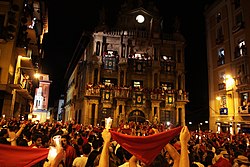
Town Hall Foursquare in the "Poor Me".
Though at that place is no formal wearing apparel code, the very common and traditional attire is white trousers, a white shirt with a red cummerbund around the waist, and a red neckerchief around the neck.[23] Some have large logos on their shirts; in the Internet age this is thought to exist a manner to highlight someone in a photo. This dress is to award San Fermin, the middle of the celebration, because of his martyr's death; the white outfits stand for the purity and holiness of a saint, and the ruby kerchiefs (pañuelos), represent his death by decapitation. A common alternate color to cerise is bluish.
Media [edit]

Hemingway drank in the Café Iruña, established 1888 in Pamplona/Iruña
The encierro of Pamplona has been depicted many times in literature, goggle box or advertisement, just became known worldwide partly considering of the descriptions of Ernest Hemingway in books The Sun Also Rises and Death in the Afternoon.[24]
The cinema pioneer Louis Lumière filmed the run in 1899.[25]
The event is the ground for a chapter in James Michener'southward 1971 novel The Drifters.
The run is depicted in the 1991 Billy Crystal film City Slickers, where the character "Mitch" (Crystal) is gored (non-fatally) from backside by a bull during a vacation with the other principal characters.

Running of the bulls in Cellar, provincial de Segovia, Espana.
The run appears in the 2011 Bollywood movie Zindagi Na Milegi Dobara, directed by Zoya Akhtar, equally the terminal cartel in the bucket list of the iii bachelors who accept to overcome their ultimate fear; death. At kickoff, the trio run part of the route. They stop at the square, just and then recover their nervus, and continue to the stop. The completion of the run depicts their freedom as they learn that surviving a mortal danger tin can bring joy.
Running with Bulls, a 2012 documentary of the festival filmed by Construct Creatives and presented by Jason Farrel, depicts the pros and cons of the controversial tradition.[26]
From 2014 until 2016, the Esquire Network circulate the running of the bulls live in the The states,[27] with both live commentary and so a recorded 'round up' later in the day past NBCSN commentators the Men in Blazers, including interviews with noted participants such every bit Madrid-born runner David Ubeda,[28] former US Regular army soldier turned filmmaker Dennis Clancey,[29] Joseph Distler, famous New York bull runner, and former British bullfighter and writer Alexander Fiske-Harrison.[30]
In 2014, a guidebook authored by Alexander Fiske-Harrison, Joe Distler, Ernest Hemingway's grandson John, Orson Welles' daughter Beatrice, and with a foreword by the Mayor of Pamplona, caused headlines around the world when ane of the contributors, Nib Hillmann, was gored past a bull soon after its publication. It was republished in 2017 under the title The Bulls Of Pamplona with a replacement chapter by Dennis Clancey.[31]
The laurels-winning 2015 feature documentary Chasing Red directed by Dennis Clancey, follows four runners during the 2012 fiesta in Pamplona, including Beak Hillmann and David Ubeda.[32] [33] [34]
Other examples [edit]

Although the nearly famous running of the bulls is that of San Fermín,[2] they are held in towns and villages across Spain, Portugal, and in some cities in southern France during the summer. Examples are the balderdash run of San Sebastián de los Reyes, about Madrid, at the end of August which is the most pop of Espana after Pamplona, the bull run of Cuéllar, considered every bit the oldest of Spain since there are documents of its existence dating back to 1215, the Highland Capeias of the Raia in Sabugal, Portugal, with horses leading the herd crossing onetime border passes out of Espana and using the medieval 'Forcåo', or the balderdash run of Navalcarnero held at dark.
Other encierros have too acquired fatalities.[35]
Correbous or bous al carrer [edit]

Bous al carrer, correbou or correbous (significant in Catalan, 'bulls in the street', 'street-bulls' or 'bull-running') is a typical festivity in many villages in the Valencian region, Terres de 50'Ebre, Catalonia, and Fornalutx, Mallorca. Another similar tradition is soltes de vaques, where cows are used instead of bulls. Even though they can take identify all along the twelvemonth, they are most usual during local festivals (unremarkably in August). Compared to encierros, animals are not directed to whatsoever bullring.
These festivities are normally organized by the youngsters of the hamlet, every bit a manner for showing their backbone and power with the bull. Some sources consider this tradition a masculine initiation rite to adulthood.[36]
Occitan area of France [edit]

An abrivado at Calvisson. The guardians are demonstrating their skill in plough a group of at least four bulls through a 360-degree plow
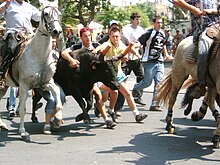
A bandido at Calvisson. Contact has been made with the bull: just it has not yet been stopped.
Numerous bull-running events happen in France in the region around Sommières, in accordance with the Camargues tradition, in which no bulls are intentionally injured or killed. For instance, in Calvisson, the almanac effect takes place around twenty July over a menstruation of five days. In that location are four events: the abrivado , in which at least ten bulls are run together through the street guided past a group of twelve gardians mounted on white Camargue horses; the encierro , in which ane bull is released outside the foyer and finds his own mode back to the pen; the bandido , in which i bull is run, accompanied through the streets; and the bandido de nuit , which is the aforementioned thing but afterward night. Boys and men run with the bulls and try and carve up them from the horses, stop them, and physically turn them away from the horses. [37]
Stamford bull run [edit]
The English town of Stamford, Lincolnshire was host to the Stamford bull run for almost 700 years until it was abandoned in 1837.[38] Co-ordinate to local tradition, the custom dated from the time of King John when William de Warenne, 5th Earl of Surrey, saw two bulls fighting in the meadow beneath. Some butchers came to part the combatants and one of the bulls ran into the town, causing a dandy uproar. The earl, mounting his horse, rode afterward the animal, and enjoyed the sport and then much, that he gave the meadow in which the fight began, to the butchers of Stamford, on status that they should provide a bull, to exist run in the town every thirteen November, for always afterwards. Equally of 2013 the bull run had been revived as a ceremonial, festival-mode community event.
Mock balderdash runs [edit]
A variation is the nightly "fire bull" where assurance of inflammable material are placed on the horns. Currently the bull is often replaced past a runner conveying a frame on which fireworks are placed and dodgers, usually children, run to avert the sparks.
The Encierro de la Villavesa ("running of the town bus") started in Pamplona on 15 July 1984 when, later the terminate of the festival, youths would run before the earliest urban bus entering the traditional encierro course. Starting in 1990, the Pamplona bus company detoured the early on passenger vehicle to defuse the take chances. Currently, the youths run before a cyclist in a yellow jersey as an homage to the Navarrese cycling champion Miguel Induráin.[39]
In 2008, Ruby Balderdash Racing driver David Coulthard and Scuderia Toro Rosso commuter Sébastien Bourdais performed a version of a 'bull running' effect in Pamplona, Espana, with the Formula One cars chasing 500 runners through the actual Pamplona route.[xl]

The Large Easy Rollergirls roller derby team has performed an annual mock bull run in New Orleans, Louisiana since 2007. The squad, dressed as bulls, skates after runners through the French Quarter. In 2012, in that location were xiv,000 runners and over 400 "bulls" from all over the state, with huge before- and after-parties.[41] [42] [43]
In Ballyjamesduff, Republic of ireland, an annual event called the Pig Run is held with small pigs. It looks just like a mini- encierro but with pigs instead of bulls.
In Dewey Embankment, Delaware, a bar named The Starboard sponsors an annual Running of the Bull [sic], in which hundreds of ruby-red- and white-clad beachgoers are chased downwardly the shore by a unmarried "bull" (2 people in a pantomime equus caballus-style costume).[44]
In Rangiora, New Zealand, an annual Running of the Sheep is held, in which 1000–2000 sheep are released downwardly the primary street of the pocket-size farming town.
The Running of the Bulls UK is a pub crawl event that takes place on London's Hampstead Heath and uses fast human runners in place of bulls.
In 2014, Pamplona inaugurated a series of running events in June, the San Fermín Marathon, of a full marathon (42.195 km), half-marathon (21.097 km), or x km road race that concludes with the concluding 900m of each race using the encierro route, runners crossing the finish line within the bullring.[45]
Since 2008 in Anchorage, Alaska during the Fur Rendezvous Festival the Running of the Reindeer sends "herds" of people running downwardly a 4-block downtown street, with a grouping of reindeer released backside them.
Opposition [edit]
Many opponents land that bulls are mentally stressed by the harassment and voicing of both participants and spectators, and some of animals may also dice considering of the stress, especially if they are roped or bring flares in their horns (bou embolat version).[46] Despite all this, the festivities seem to have broad pop support in their villages.[47]
The city of San Miguel de Allende, Mexico, cancelled its Sanmiguelada running of the bulls later 2006, citing public disorder associated with the event.[48] After the effect was cancelled in San Miguel, the metropolis of Salvatierra, besides in the state of Guanajuato, picked upwardly the event. It is now called La Marquesada and the iii-twenty-four hour period consequence is held during the last weekend of the month of September or first weekend of October.
As of 2002, a Running of the Nudes occurs two days earlier the running of the bulls. The upshot is supported by animal welfare groups, including PETA, who object to the running of the bulls, claiming that information technology is fell and glorifies bullfighting, which the groups oppose.
Further reading [edit]
- Fiske-Harrison, Alexander, ed. (2018). The Bulls Of Pamplona (one ed.). Mephisto Printing. ISBN978-1986500272.
- Hillmann, Bill (2015). Mozos: A Decade Running with the Bulls of Espana. Chicago, Illinois: Curbside Splendor Publishing. ISBN978-1-9404-3053-ix.
- Hillmann, Bill (2021). The Pueblos: My Quest to Run 101 Bull Runs in the Pocket-sized Towns of Espana. Chicago, Illinois: Tortoise Books. ISBN978-1-9489-5417-4.
- Etxanobe, Ander (2021). The Basque: An American's Journeying to Embrace His Roots. Txapela Publishing. ISBN978-1736948101.
Run into also [edit]
- Bou embolat or toro embolado – variant in which bulls have flares or fireworks attached to their horns
- Bull-baiting
- Bullfighting
- Spanish-style bullfighting
- Bull-leaping (ancient)
- Course landaise (modern France)
- Recortes (modern Espana)
- Balderdash running – a like, defunct tradition in England
- Jallikattu – a similar tradition in Tamil Nadu, Bharat
- Sokamuturra , similar to the encierro, spread over different parts of the Basque Land
References [edit]
Some links may incorporate graphic content where marked.
- ^ a b c Fiske-Harrison, Alexander (editor) The Bulls Of Pamplona, Mephisto Press, 2018
- ^ a b c d east "Sanfermin guide: Running of the bulls". Kukuxumusu. 2007. Archived from the original on 5 May 2008. Retrieved 21 July 2008.
- ^ "Bull-run hits liquor-fueled town", 2 Feb 2009. "The tradition, enacted in a handful of Mexican towns, traces its roots back to the centuries-old Pamplona bull-run in Mexico's former colonial power." Retrieved four March 2009.
- ^ Co-ordinate to the Mayor of Pamplona in his foreword to the volume Fiesta: How to Survive the Bulls of Pamplona
- ^ "Running of the Bulls 2011 Live Stream, Pamplona San Fermin Festival Webcam Feed". PRLog. v July 2011.
- ^ "Running of the Bulls 2021 Officially Cancelled". www.runningofthebulls.com. 26 April 2021. Retrieved vi July 2021.
- ^ "Running of the Bulls 2022 Dates". www.runningofthebulls.com. 5 Apr 2021. Retrieved 6 July 2021.
- ^ "27 años de Sanfermines en TVE". RTVE.es. Corporación de Radio y Televisión Española. 2008. Retrieved 21 July 2008.
- ^ a b c d e f g h i j k "The Bull Run". Pamplona.net. Ayuntamiento de Pamplona (Quango of Pamplona). 2008. Archived from the original on 29 May 2008. Retrieved 21 July 2008.
- ^ a b "Sección quinta". Bando San Fermin 2014. Ayuntamiento de Pamplona. Archived from the original on two April 2015. Retrieved 20 March 2015.
- ^ "Encierro bullrun San Fermin festival Sanfermines tourist information on Navarre". Government of Navarre. Retrieved 8 March 2010.
- ^ a b Alonso, Gorka (xv July 2013). "Los encierros se saldan con fifty heridos trasladados y 6 corneados". Noticias de Navarra (in Spanish). Archived from the original on 16 July 2013. Retrieved xv July 2013.
- ^ "Los encierros de 2012 dejan cuatro heridos por asta, los mismos que en 2011". Diario de Noticias (in Spanish). 14 July 2012. Archived from the original on 19 July 2012. Retrieved 13 July 2013.
- ^ "Quinta mujer corneada en los encierros de San Fermín" (in Spanish). Diario de Navarra. EFE. fourteen July 2013. Retrieved 15 July 2013.
- ^ Doria, Javier (13 July 2013). "Montón en el encierro de Sanfermines, un peligro con historia". El País (in Castilian). Retrieved 14 July 2013.
- ^ "Especialistas destacan que el dispositivo sanitario de los encierros "no se puede mejorar" porque es "espectacular"". Diario de Navarra (in Spanish). 18 June 2009. Archived from the original on 4 November 2013. Retrieved sixteen July 2013.
- ^ "Homo dies subsequently being gored at Spanish bull-running festival". Reuters. 31 October 2021.
- ^ a b c d e f g h i j yard "La muerte de hoy es la número quince en la historia del encierro". Terra Noticias (in Spanish). Retrieved 6 July 2012.
- ^ "The concluding person killed at Pamplona". BBC News. British Broadcasting Corporation. 14 July 2005. Retrieved 10 July 2009.
...Matthew Tassio...22 years former and came from Chicago...The...balderdash...hit him in the abdomen, severed a main artery, sliced through his kidney and punctured his liver
- ^ "Muere el pamplonés Fermín Etxeberria, de 63 años, herido en el encierro del 8 de julio". DiarioDeNavarra.es (in Spanish). 25 September 2003. Archived from the original on 3 Baronial 2009. Retrieved x July 2009.
- ^ "Balderdash gores man to expiry in Spain". BBC News. 10 July 2009. Retrieved 10 July 2009.
The 27-yr-former was gored in the cervix on Friday, during the fourth bull run of the week-long San Fermin festival. Daniel Jimeno Romero, from Madrid, had emergency surgery in hospital but died of his injuries. Earlier reports had described the dead human every bit British....a veteran Spanish bull-runner died after a fall in 2003
- ^ "One dead in the running of the balderdash's in Pamplona". EncierroSanFermin.com. 10 July 2009. Archived from the original on fourteen July 2009. Retrieved 10 July 2009.
A runner died in today's running of the bulls in the northern spanish city of Pamplona, the bull running held during the famous San Fermin festivities. The man died after being gored in the neck and lung by a balderdash of the Jandilla ranch, named "Capuchino".The runner, Daniel Jimeno Romero from Alcalá de Henares (Madrid) was at the end of the street run
- ^ Tan, Rebecca (six July 2018). "As balderdash run revelry kicks off in Pamplona, hundreds wear black to mourn victims of sexual assault". Washington Post.
- ^ "Hemingway in Kingdom of spain. A definitive guide to Ernest Hemingway'south Kingdom of spain". 15 March 2022.
- ^ Encierro de toros in the Spanish-language Auñamendi Encyclopedia.
- ^ Running with Bulls at IMDb
- ^ 'Running Of The Bulls', Esquire TV
- ^ Vadillo, Jose Luis. 'Así son los corredores de elite en San Fermín', El Mundo. 6 July 2015
- ^ Editorial Staff. "Pamplona, bull running, bull gorings, Esquire Television receiver and poetry from New York", The Pamplona Post. ten July 2015
- ^ "Running of the Bulls 2015: A Democratic Sport" Archived 17 July 2015 at the Wayback Machine, Esquire TV
- ^ Fiske-Harrison, Alexander, "The Bulls Of Pamplona
- ^ "The People Trying to Utilise Engineering science to Save Nature". 15 May 2021.
- ^ "Chasing Carmine (2020) - IMDb". IMDb.
- ^ "This Iraq war veteran has been running with the bulls since 2007". 5 Feb 2020.
- ^ Mari Carmen López del Burgo, aged 48, from Madrid, Kingdom of spain. "Muere una mujer embestida por un toro en los encierros de Arganda del Rey". ElPais.com (in Spanish). ix September 2010. Retrieved 9 September 2010.
- ^ Touristic leaflet. Festes de la Costa Blanca, Diputació Provincial d'Alacant, 2006, Alacant.
- ^ "Taurine traditions". OT-Sommieres.com. Office de Tourisme du Pays de Sommières. Retrieved 22 August 2017.
- ^ Chambers Book of Days (1864). W. & R. Chambers Ltd. 1832. 13 Nov entry
- ^ Rolán, Saioa (8 June 2022). "Encierro de la Villavesa: qué es, cuándo se celebra y curiosidades". diariodenavarra.es (in European Spanish). Retrieved vii July 2022.
- ^ "Red Bull to visit Pamplona for Bull running". GPUpdate.internet. eleven June 2008. Retrieved 30 January 2011.
- ^ Marszalek, Keith I. (24 June 2007). "Big Easy Rollergirls to reinact [sic] famed bull run". Blog.NOLA.com . Retrieved 2 July 2011.
- ^ "San Fermín in Nueva Orleans, The Running of the Roller Girls". Laughing Squid. 20 July 2008. Retrieved two July 2011.
- ^ Coviello, Will. "Running of the Bulls 2012". Gambit Weekly . Retrieved eighteen July 2012.
- ^
- Cormier, Ryan (23 June 2017). "Turning 21, party fourth dimension for Running of the Bull". The News Journal. Wilmington, DE.
- Driscoll, Ellen (5 July 2019). "Running of the Balderdash takes over Dewey Beach". Cape Gazette. Lewes, DE.
- Gonzalez, Lucas (26 June 2019). "Dewey Beach'southward Running of the Bull: The zany hit of summer". The Daily Times. Salisbury, Doc.
- ^ "Home2018 - EDP San Fermín Marathon". SanFerminMarathon.com.
- ^ Article sobre la crueltat dels bous al carrer. Archived 12 October 2007 at the Wayback Machine (in Catalan)
- ^ Commodity sobre la popularitat dels bous al carrer a les terres de 50'Ebre. (in Catalan)
- ^ "No More Bull (Running, That Is) in San Miguel de Allende," Archived 7 June 2011 at the Wayback Machine Austin American-Statesman, 24 May 2007. Retrieved 4 March 2009
External links [edit]
- Definitive Guide to Running with Bulls, Pamplona's Running of the Bulls, How To
- A web log well-nigh Pamplona's almanac bull-running festival
- How to attend or view the Pamplona festival
- Educatee Travel and Party at Running of the Bulls
- Google Maps Route Map
- Running of the Bulls Tours
Source: https://en.wikipedia.org/wiki/Running_of_the_bulls
0 Response to "How To Run With The Bulls"
Post a Comment